What's all this then?


My name is Victoria Stiles and I'm an Early Career Historian currently doing whatever odd research / consulting / outreach / tutoring jobs come my way. I blog here about some of the interesting texts I've found.
My research focusses on books about Britain and the British Empire which were in circulation in Nazi Germany but you'll also find a smattering of school textbooks, witchcraft beliefs, bog drainage, bemused travellers and weird illustrations that caught my eye.
Translations from German are my own. Comments are currently unmoderated and are mostly spam for leather jackets anyway.
Showing posts with label Germany. Show all posts

Sunday, 1 April 2012

Reading for the Reich

This set of advertisements to promote reading was offered to booksellers by the Bund Reichsdeutscher Buchhändler. They're taken from Börsenblatt für den deutschen Buchhandel, February 1936, and I wish I'd taken better photos.


"Your books are your best friends"


"Benefit from the experience of others, read technical literature!"


"Masters: let your apprentices read books!"


"Books help you through life"


"Use your free time, read a book"


Here's that last one as part of a display:


And because no part of 1930s Germany was all sweetness and light, one poster is a quote from Hitler about how he benefitted from extensive reading: " Still, nice tablecloth they've got in that window huh?


Do machines eat people?

"Or are they freeing them from slavery? Walther Kiaulehn's hard-hitting book "The Iron Angel" provides a chronicle of inventions from the antique to the modern age, a moving history of the spirit which created the machines, a cultural history of human work and power, a thoroughly optimistic philosophy of technology."

Book advertisement from "Börsenblatt für den deutschen Buchhandel", January 1936.

Saturday, 4 February 2012

Hitler wasn't racist either, but...

Having written a bit about the problems of "trivialising" the Nazis last time, I hope I'm not going to come across as too flippant here. On the other hand, I didn't want to shy away from quoting Adolf Hitler directly*, as it's important to know what he said and what effect this might have had on his audience, rather than treating his words as though they'll conjure up demons. I'm not particularly satisfied with this translation, and have included the original at the end of this post for easy reference.

Although I found in difficult to render the crucial sentence (here in bold) in English, I was struck by how similar it is to sentiments expressed quite freely in Britain today; that there is nothing wrong with other races and cultures, but that they should exist seperately and the culture and rules of one should not be forced upon another. In this case, parallels are being drawn between British rule in India and Jewish "imperialism" in Germany. Nowadays, the fact that the European way of doing things was being exported long before the (alleged) attempted introduction of, for example, Sharia Law to European countries, tends to be ignored.
Our attitude towards other races is that of objective disinterest. Just as with the Indian people, the German people is made up of several races and tribes. The Indian people, with its four-thousand-year-old culture, has developed its own racial laws, which cannot easily be translated into a European context. Dr. Goebbels is quite right to say that it is incorrect to speak of races of lesser value. No race is inherently inferior to another; at most, the different races which populate the earth are of differing value. This applies also to the Jewish race. The Jew is not inherently inferior within his own environment, but his outlook is not a good fit for the German people, and can in fact be damaging. For that reason, the Jews must endeavour to live as a separate people. Each race must find within themselves their own world and this is why we are quite right to defend ourselves against another race's attempts to force their peculiarities upon us, as the Jews have done in Germany.
What I want to get across here is that fact that almost nobody wants to admit to being racist. Everyone knows that racism is unacceptable. However, there are many ways to twist the definition of racism so that it happens to exclude the views that you hold and the policies you are advocating. This goes for people even as unashamedly racist as the leaders of the Nazi party, if they were called upon to account for their views: they had nothing against other races, you understand, they merely recognised that different races have different strengths and weaknesses, and will thrive better in their own habitat. They were worried that combining more than one in the same place would inevitably cause damage. Every race has the right to an area which belongs only to them and not to have alien laws and habits forced upon them. If a race such as the Jews have no place where they belong then one can be found for them but really this is their responsibility. And, partly for their own good, they can't be allowed to take up space which belongs to another race. Of course they have nothing but our good wishes, so long as they conform to this natural order, but due to the difficulties involved and their unwillingness to cooperate then if they were to... disappear from this scheme it would greatly benefit the world in years to come. But none of this is "racist"; it's just recognising the nature of things. See?

There are very few self-confessed racists in the world, BUT... people still die purely because they are considered to belong to the wrong race for the bit of earth they're standing on. That fact should be what we reach for, when getting lost among the excuses.

*These words are from official notes taken of an interview between Hitler and Indian journalist Dr. Sinha, 6th December 1935. They are quoted in an article by Johannes H. Voigt: 'Hitler und Indien' in Vierteljahreshefte für Zeitgeschichte, vol. 19/1 (Jan. 1971) pp.33-63. It is not clear how accurately they record Hitler's specific phrasing.

"Unsere Einstellung zu anderen Rassen sei die einer objektiven Desinteressiertheit. Genau wie das indische setze sich auch das deutsche Volk aus mehreren Rassen und Stammen zusammen. Das indische Volk mit seiner vieltausendjährigen Kultur habe sich eigene Rassengesetze gegeben, die auch nicht ohne weiteres auf europäsche Verhältnisse zu übertragen seien. Dr. Goebbels habe ganz recht, wenn er es als unrichtig bezeichne, von minderwertigen Rassen zu sprechen. Keine Rasse sei an sich minderwertig; die verschiedenen Rassen, die die Erde bevölkern, seien höchstens untereinander anderswertig. Das gelte auch für die jüdische Rasse. Der Jude sei an sich nicht minderwertig in seinen Anlagen, aber seine Auffassungen paßten nicht für das deutsche Volk, sie seien vielmehr geradezu schadlich, und deswegen müsse der Jude dafür sorgen, daß er für sich allein als Volk leben könne. Jede Rasse müsse ihre Welt in sich finden, und darum wehrten wir uns mit Recht dagegen, daß uns eine andere Rasse ihre Eigentümlichkeiten aufzuzwingen suche, wie es die Juden in Deutschland getan hatten."

Tuesday, 31 May 2011

On the cliquishness of minorities


Two quotes, out of what I assume is a huge number of similar examples. The first is Frederick the Great surveying his new Polish territory, quoted in Vejas Gabriel Liulevicius, The German Myth of the East: 1800 to the Present (Oxford, 2009), pp.37-8:

In 1772, he wrote to Voltaire of the Poles as the 'last people in Europe'. Likewise, he expressed dissatisfaction with the Jewish presence in the towns of the frontier provinces, concluding however that they were necessary 'on the Polish border because in these areas the Hebrews alone perform trade. As soon as you get away from the frontier, the Jews become a disadvantage, they form cliques'.

The second is from David Cameron's recent speech on immigration (which I blogged about at the time, here). The full text of this is on the BBC website:

In one case, an applicant applied as an 'Elite Chef' for a fried chicken shop. The main qualifying criterion was the rate of pay. So in this case, his sister, who owned the shop decided to pay him exactly the amount that allowed him to qualify. There was nothing the authorities could do and he was allowed in.
So it has fallen to this government to sort out the system - and we are completely changing the way it works so it is truly geared to the needs of our economy.

Rather than suggesting that Cameron is the reincarnation of Frederick the Great, the point I'm trying to make is this: Minorities have often been attacked on the basis that they band together to help each other, excluding the majority population, and therefore securing advantages for themselves. If this does happen it's because the majority, especially in boom times, don't need to forge such close networks to deal with problems. It makes more sense to move away from home to somewhere you can find a job you want to do, which you stand a good chance of getting because you're fluent in the right language and fit in with the dominant culture there. You may not need to be around to take care of parents, elderly relatives, younger siblings and cousins, because they have full access to state services. Immigrant communities have stronger bonds because they need them. Partly as a consequence of this, and in turn causing it, groups of such workers can be very useful to the national economy, as shown by both of the above quotes.

No resemblance: David the Great and "Just Call Me" Freddy

The problem comes when the economy contracts again, and everyone needs to fall back on their support network. Minorities may then seem to have an unfair advantage, because they are used to dealing with hardship and have informal systems in place for helping everyone in their community to scrape by. Similar to people failing means tests because they have spent twenty years in work carefully putting a little money aside each month, minority communities may end up punished for their previous organisation, thrift and hard work.*

The best historical example of this would be the fate of Jewish communities in Europe. Legally barred from other professions, they came to specialise in finance and in the trade in second-hand goods. During the economic crisis following the depression, most people existed in a world of torture and deprivation, defined by these two industries. On the one hand life-savings became worthless and interest on new loans was crippling. On the other, possessions had to be sold off cheap, and essentials such as clothes and shoes bought after a lot of haggling and pleading. Because of the ways they had had to deal with previous discrimination and hardship, Jewish communities seemed to be easily profiting from Germans' misfortune. Coupled with the pervasive myth that it was a worldwide Jewish conspiracy that had caused the crash in the first place, this was a very toxic mix.

Immigrants and other minorities make naturally easy targets. Politicians should be wary of criticising them, however subtly, for those same patterns of behaviour they have been forced to adopt. When stuck between a rock and a hard place, it's natural to want to give each other a leg-up.


*That isn't to say that majority white communities in Britain have not undergone extended periods of hardship. There are countless examples, particularly in former industrial or mining towns. My focus here is on communities who are easily distinguishable from a majority population who consider themselves to have been in that area longer.

Saturday, 28 May 2011

Sehr geehrter Herr Hitler...

Fascinating latter from Hitler to a British newspaper, declining their offer to publish his thoughts on the economic crisis: http://www.lettersofnote.com/2010/06/yours-faithfully-adolf-hitler.html
I'm especially impressed by the translation, which has maintained the pompous, slightly rambling style of the original.

Wednesday, 31 March 2010

England's Mask has Fallen - Index

Another one from the British Library. England's Mask has Fallen (,,Englands Maske ist gefallen") is a 68-page paperback from 1939 with no attributed author. Priced at 30 Pfennig, it has the same cheap, flimsy feel to it as ,,Das ist England!" and the cover style is strikingly similar. I couldn't find a picture online (although there's what seems to be an abridged version knocking about on ebay and some rather questionable online bookshops) so a description will have to do.

Imagine, if you will, an angled, three dimensional map of the British Isles, with London marked as a black hole. Thin waves of smoke emanate from this blot, forming the shape of a looming figure of death, complete with scythe. In front of him is the disembodied head of Winston Churchill, with obligatory cigar and Union Jack top-hat. The title is jovially scrawled across the top in red, cartoonish letters. Classy, I think you'll agree.

For such a short publication, the index is amazingly detailed, although the subheadings don't appear in the main text (and until I read the whole thing, I wouldn't trust all of my translations):

The Strangler at her Side
England conducts an economic war - Pirates for centuries - The destruction of Poland is a slap in the face for England - English freebooters across the globe - How England robbed Spain, Holland, Portugal and France of their former power - The old enemy of neutral countries - Germany's correct treatment of neutral countries - England's blockade, this time without hope of success.

A Hero's Death for Money
England praises with silver bullets - Money, the soul of England's policy - Poland as the latest victim of English warmongering - South-east Europe withdraws from England's moneybag policies - Dishonourable English controls - The City charges usurious interest - England's currency wavers - Isolation attempts fall apart - Security in Europe only possible without England's machinations.

The Poison Trade
The infamous Opium War against China - A people's health is ruined - England destroys Chinese cultural artifacts - England's typical mass-smuggling operation - Use of violence against Chinese protests - England's ever-increasing blackmail of China - Trust in England not justified.

Protector of the Jews
The Jews rule in England - Kings and lords in the service of Jews - Jewish war profits in England for centuries - The Jew in the British Parliament - All influential positions overrun with Jews - Cromwell and Queen Elizabeth in Jewish hands - A Jew as British Prime Minister.

Hunger and Superstition
Areas of poverty in England - Terrible plight of the unemployed - A hundred thousand unemployed Englishmen undernourished - English working class families going hungry for years - The youth without vocational training - The impoverished people of England suffer from despair - Comfort through a love of gambling - The unemployed gamble away their pittance - Football betting a mass swindle - The richer England fails to care for the sons of its homeland.

An Empire Expires
Weakening vitality of the English nation - Decline of the population - Birth rates too low - England is aging - The old English hypocrisy - Birth rates in the British Empire also developing unfavourably - The English unwilling to raise families - 25 percent increase in birth rate needed to maintain England's population - The English no longer a pioneering people, but colonial rentiers - England's demographic and political decline.

Time is working against England
Germany has prepared in time - A long war is to England's disadvantage - England's currency in free-fall - England losing ground in world trade - Question mark over British Army's oil supplies - England's dependence on iron and food imports - England must risk her foreign possessions - England's gold reserves pumped dry - England's power is crumbling - Time is on Germany's side.


The two things that strike me about the structure, as set out above, are the amount of repetitions and the lack of chronology. I'll be interested to see how coherent the whole text is, and what level of detail is provided.

Tuesday, 30 March 2010

"That's England!" Cover and index

I had my first visit to the British Library a few weeks ago (such a wonderful, friendly, relaxing place that for the first time ever I actually wished I lived in London) and looked at a couple of Nazi-era books on the British Empire. Time and money constraints meant that I only made a few notes and copied down the indexes, but they're illuminating enough.

First up, That's England! World Domination through Blood and Gold by Fritz Reipert, published either 1939 or 1940. It's only forty pages long, cheaply bound and priced at 40 Reichsmarks*. The cover alone puts it firmly in the categories 'popular' and 'subjective'.


Index: (Bear in mind that German employs exclamation marks far more liberally than English. The author also uses 'Britain' and 'England' interchangeably.)
1. England - same as ever!
2. The bloodstained path to a British Empire
3. The sanctity of contracts - as England sees it!
4. England in the stocks!
5. British conduct during the World War
6. Versailles: new edition - England's dream!
7. German peacekeeping - English warmongering
8. England is to blame for the war!
9. England's blood-guilt in Poland
10. Lies and horror stories - England's weapons!
11. Abuses of neutrality - the prerogative of British warfare
12. England's last resort - hunger blockade!
13. England's big mistake!

*Trying to figure out what that is in today's money, or any other meaningful comparison has me beaten so far. I'm still working on it.

Saturday, 10 October 2009

"the most worthy-to-be-visited of all historicoromanticalbeautyspotagglomerations"

Title: Germany
Author: Gerald Bullett

This is my first purchase since moving back to England. It's from "Black's new series of coloured books" and has 32 colour illustrations by E.T. Compton and E.Harrison Compton (who I think did the illustrations for other books in the series too).


It was published in 1930 and the text has a whimsical P.G. Wodehouse / Jerome K. Jerome feel to it. The reader and three travelling companions - a brother and sister as well as the author - are touring Germany together, very much not mentioning the war. We start our sightseeing in Cologne:

And, let me confess at the outset, we have not among all three of us more German than could be written on the back of a postcard. When Alf was at school the language of Goethe and Beethoven fell into disgrace before he had begun to master it; Angela, for a similar reason, was never given a chance; and so it falls to me to be the linguist of the party. I do my best; and the resulting dialogue, if it could be rendered in English, would be something after this fashion:
Q. Please how much clock goes the boat by with or from Cologne?
A. (but this, you must understand, is pure guesswork). Please a very fine express steamship will in the early morning down the beautiful Rhine a much-to-be-enjoyed journey make.
Q. Boat. The Rhine. How much clock?
A. The distinguished gentleman will the ancient and sumptuous castles on the many hills situated to enjoy not fail.
Q. Please how much clock?
A. It is the considered opinion of ladies and gentlemen the best and wisest that the Rhine country is in the whole world the most worthy-to-be-visited of all historicoromanticalbeautyspotagglomerations.
Q. What is the weather? I wish, how much clock?
A. Please very much.

In the end we discover what we want to know from a time-table hanging on the wall; and, having time to spare, we go and look at the Cathedral. [...] When you suddenly come upon it in the middle of Cologne its size and splendour make you gasp. And inside, lost in its vastness, you almost wish it would dwindle and become a small parish church. (pp.2-4)

And just because I like showing off, here are some of my photos of Cologne Cathedral, taken last month.


Monday, 24 August 2009

A Nazi-Era History of Hamburg

... Not that you'd really know, for the first three quarters of the book. And I was looking very closely for signs of fanatical revisionism because these 80 page volumes from Christmas 1941 come with a “get well soon” message from Hamburg Gauleiter Karl Kaufmann - a name which by rights should be as infamous as Goebbels, Goering and Himmler.

"Get well soon" message

It briefly describes Hamburg’s development from a small, dependent settlement on the Elbe, to a wealthy, independent merchant city, to Germany’s largest harbour and gateway to the world. At no point does it mention the contribution of Jewish merchants to Hamburg’s prosperity but then it doesn’t mention Jews at all. Apart from taking the side of the Saxons against Charles the Great, Hamburg’s earlier history is dealt with in the same brief, upbeat, “didn’t we do well” manner you find in most local museums.
There are some facts about Hamburg’s prominence after the French Revolution which might not stand up to scrutiny; apparently, all of England’s trade with mainland Europe ran through Hamburg, and it was this English connection that dragged the ever-neutral Hamburg into the fight against Napoleon, in which they suffered the worst treatment imaginable. Then we hit the World War One, in which Hamburg allegedly proves its loyalty to Germany and shares in its cruel treatment at the hands of its opponents:

The historical development of our city could easily create the impression that Hamburg had placed her own interests over those of Germany. However, we must not overlook the fact that it was only through this political independence that the Hamburg’s inner strength of purpose, enterprising courage, tenacity in the face of set-backs, and flexibility in the conquering of new markets could develop, and could blossom among Germany’s ranks. The successful utilisation of these qualities for the city simultaneous meant service to the interests of Germany; Hamburg’s profile in the world was Germany’s vindication, Hamburg’s economy was the German economy. The fact that Hamburg, despite all her international connections and despite the various points of contact with foreign ways and customs, remained truly German at heart, is proven by the inscription on the memorial columns in Adolf Hitler Square: “40 000 sons of this city gave up their lives for you!” (p.62-3)

Der geschichtliche Werdegang unsere Stadt könnte wohl den Eindruck erwecken, als ob Hamburg seine eigenen Interessen über die Deutschlands gestellt hätte. Es darf aber nicht übersehen werden, daß sich nur in dieser politischen Selbständigkeit die den Hamburgern innewohnende Tatkraft, der Mut zu großen Unternehmungen, die Zähigkeit bei Rückschlägen und die Geschicklichkeit bei der Eroberung neuer Märkte entwickeln und in den Zeilen der deutschen Zerrissenheit ungehindert entfalten konnten. Der erfolgreiche Einsatz dieser Kräfte für die Stadt bedeutete aber gleichzeitig Dienst an den deutschen Interessen; denn Hamburgs Ansehen in der Welt war Deutschlands Geltung in der Welt, Hamburgs Wirtschaft war deutsche Wirtschaft. Daß der Hamburger trotz aller internationalen Bindungen und trotz der vielfachen Berührungen mit fremdlündischer Art und Sitte in seinem Kern echt deutsch geblieben ist, beweist die Inschrift an der Gedenksäule am Adolf-Hitler-Platz: ,,40 000 Söhne dieser Stadt ließen ihr Leben für euch!”

This paragraph shows one of the problems that more extreme nationalists faced in Germany. The aims of independence and unity had mostly been achieved but people’s identity was (and to some extent is) bound to their city or region. This must have been especially strong in Hamburg - the most successful of the old hanseatic cities - which had fought so long for independence from outside interference and restrictions, and which was very international in its outlook. This combination of weak internal ties and strong international ones meant that, similar to their Italian counterparts, the Nazis had to work hard to create a sense of the whole of Germany standing shoulder to shoulder against the rest of the world.

Front cover

And so onto the next chapter, dealing with the First World War and its aftermath:

Hamburg’s decline
The development of the German state ran almost parallel with the proud developments in Hamburg. The kingdom which had been created in Versailles in 1871 had become a great power, whose flag flew over all seas, whose hard work had led to the creation of her colonies, and whose highly-valued industrial wares were gladly bought in all the world’s markets. It had also become a military power, with a decisive voice in Europe.
The rise of the state, whose glory sadly hid here and there bitter political and social injustice, was viewed as increasingly dangerous by other world powers. They were working on a plan of war against Germany.
The shot in Sarajevo, hardly thought to be significant at first, was the decisive signal. Within only a few weeks almost the whole globe stood in arms against Germany. The state marched into the greatest war in the whole of history. At one stroke, all the life which had given Hamburg its face died out in the city. Hardly a single ship left the harbour. The trade fleet floated in long lines against the quayside, was interred in enemy ports or stayed in neutral harbours.
Large and small ships served as support vessels. Many sank under fluttering flags of war. Life in the shipyards continued regardless. One after the other, battleships grew on the Helligen [?*]. Men and women stood at the lathes, in order to supply the fighting front with granades.
However, a hunger blockade lay around Germany like an iron belt. Women and children were becoming paler. Hunger was found everywhere in Germany and Hamburg. The Hamburg Regiment, the 76th Infantry regiment, had gone to the front in the very first days of the war. In difficut battles it had bled for the great empire. [...] Then came, whilst the front was still standing, Germany’s most shameful hour: revolution in Germany. (p.64-7)

Hamburgs Niedergang Mit Hamburgs stolzer Entwicklung fast gleichlaufend war die Entwicklung des Reiches gegangen. Das in Versailles 1871 entstandene Kaiserreich war zu einer Großmacht geworden, deren Flagge auf allen Meere wehte, die mit Fleiß sich der Erschließung ihrer Kolonien widmete und deren hochwertige industrielle Güter auf allen Märkten der Welt gern gekauft wurden. Es war außerdem eine militärische Macht geworden, die in Europa ein entscheidendes Wort mitzusprechen hatte. Der Aufstieg des Reiches, hinter dessen Glanz sich allerdings hier und dort bittere politische und soziale Ungerechtigkeit verbarg, ward in den Augen anderer Großmächte für diese immer gefährlicher. Planmäßig arbeiteten sich auf einen Krieg gegen Deutschland hin. Der Schuß von Sarajewo, zuerst kaum gewertet, war das entscheidende Signal. In wenigen Wochen stand fast die ganze Erde gegen Deutschland in Waffen auf. Das Reich zog in den größten Krieg der Geschichte aller Zeiten. Mit einem Schlag erstarb in Hamburg alles Leben, das ihm bis dahin sein Gesicht gegeben hatte. Kaum ein Schiff mehr verließ den Hafen. Die Handelsflotte reihte sich in langer Linie an den Keimauern, war in feindlichen Häfen interniert oder lag in neutralen Häfen. Große und kleine schiffe taten als Hilfskreuzer Dienst. viele sanken unter wehender Kriegsflagge. Das leben auf den Werften aber ging unentwegt weiter. Kriegsschiff auf Kriegsschiff wuchs auf den Helligen. Männer und Frauen standen an den Drehbänken der Fabriken, um der Kämpfenden Front die Granaten zu liefern. Um Deutschland aber legte sich wie ein eiserner Gürtel die Hungerblokade. Frauen und Kinder wurden bleicher und bleicher. Der Hunger ging um in Deutschland und Hamburg. Das Hamburger Regiment, das Infanterieregiment 76, war in den ersten Kriegstagen schon nach dem Westen gegangen. In schweren Schlachten blutete es für das große Reich. [...] Dann kam, während die Front noch stand, Deutschlands schmählichste Stunde: Revolution über Deutschland.


Again, no mention of Jews or even weak liberals, and no resort to stabbed-in-the-back imagery. These are all elements I’ve been taught to expect from Nazi propaganda dealing with the end of the First World War, and they are all conspicuously absent.
Back to the text, and the “revolution”: Workers begin to demonstrate in Hamburg, stirred up by outsiders but also by anger; their wives and children are starving, their politicians have betrayed them and they are effectively disenfranchised by Hamburg’s class-based voting system. All of these things apparently make life easy for Marxist agitators. Hamburg’s soldiers return to find a “town beset by choas and hunger, wailing masses and incompetent leaders.” (p.67: aufgewühlte, hungernde Stadt, lärmende Pöbelhaufen and unfähige Führer. Die vierzigtausend Söhne der Stadt schienen umsonst gefallen zu sein.) Hamburg in the hands of the workers doesn’t provide much work, though the author also refers to international reasons for the crisis:

Hamburg becomes a national-socialist city
The heart of Hamburg, the harbour, and its life-blood, the ships, showed how Germany’s largest harbour was dependent almost exclusively upon trade across the globe. The decline of the world economy hit Hamburg hard, doubly so, as it was quite clearly shown in this and later years just how senseless the demands made by our opponents in the World War were.
Thousands and thousands lost their jobs, ship after ship was chained up in Walterhofer Harbour, machines rusted, factories fell into disrepair, life expired again in Hamburg. Year after year passed by, and each held less comfort than the last. (p.72)

Hamburg wird eine nationalsozialistische Stadt Hamburgs Herz, der Hafen, und sein Element, die Schiffe, zeigten, wie sehr Deutschlands größter Hafen fast allein abhängig war von Handel und Wandel in der Welt. Der Rückgang der Weltkonjunktur traf Hamburg schwer und hart, traf es doppelt hart, da sich in diesem und in den späteren Jahren erst richtig zeigte, wie sinnlos die Forderungen der Weltkriegsgegner waren. Tausende und tausende wurden erwerbslos, Schiff am Schiff wurde in Walterhofer Hafen an die Kette gelegt, Maschinen rosteten, Fabriken verödeten, das Leben erstarb wieder in Hamburg. Jahr um Jahr kam herauf und versank. Und jedes Jahr war trostloser als das andere.

According to the book 1929, first year of the Great Depression, was a decisive year for Hamburg because Adolf Hitler appointed Kaufmann as its Gauleiter. He is to unite the squabbling factions in the local branch of the NSDAP and “win” Hamburg for the national-socialists. The next passages are full of war metaphors (which are pain to translate) and there is a definite conflation of an election campaign with a military campaign (the German word Kampf has many uses).

For weeks and months the drumfire from National-socialist meetings rang out over the proud, dying city. The different groups within the party aligned themselves firmly behind their Gauleiter. In difficult battles in meeting halls they showed their political opponents that they were willing to meet terror with terror.
However, as the National-socialists grew, so did the communists. the front lines became clearer. On both sides stood fanatics. On both sides stood fighters.
And so, in 1930, Paul Keßler became the first National-socialist to fall. The fight became bloody. During the campaign for the Reichstag elections, the communists’ best troops, the Red Marines, were soundly beaten. (p.73-4)

Wochenlang, Monatenlang geht über die stolze, sterbende Stadt das Trommelfeuer nationalsozialistischer Versammlungen. Die verschiedenen Gruppen der Partei richten sich klar auf ihren Gauleiter aus. In schweren Saalschlachten zeigen sie dem politischen Gegner, daß sie gewillt sind, Terror gegen Terror zu stellen. Mit den Nationalsozialisten aber wachsen auch die Kommunisten. Die Fronten werden klarer. Auf beiden Seiten stehen Fanatiker. Auf beiden Seiten stehen Kämpfer. De fällt, 1930, als erster Nationalsozialist Paul Keßler. Der Kampf wird blutig. Im Reichstagswahlkampf wird die beste Truppe der Kommunisten, die rote Marine, zusammengehauen.

And so the strident prose continues, with more fighting, both politically and on the streets. More talk of fanatics, of Hamburger workers, of deaths in the ranks. The tone changes suddenly and we learn that two important organisations within the NSDAP were founded in Hamburg. Then we return to a list of party members who died, including one who was “shot down”, though we aren’t told who did the shooting. Finally, the breakthrough (although we don’t learn exactly how this was achieved):

By April 1932 the NSDAP is Hamburg’s strongest party. New electional campaign continue to come. The depression continues to worsen. The number of people without work continues to rise. Germany, and with her Hamburg, seems ready to lie down to die. Then, in January 1933, Adolf Hitler becomes Chancellor of Germany, and a few weeks later Hamburg’s government becomes National-socialist. (p.75)

Im April 1932 ist die NSDAP. Hamburgs stärkste Partei. Immer neue Wahlkämpfer kommen. Immer größer wird die Not. Immer mehr Menschen sind ohne Arbeit. Deutschland und mit ihm Hamburg scheinen sich zum Sterben legen zu wollen. Da wird, man schreibt Januar 1933, Adolf Hitler Reichskanzler und Hamburgs Regierung wenige Wochen später nationalsozialistisch.

Title page with drawing of a large wooden buoy

The final chapter affected me quite strongly. It claims that the Nazis delivered the population of Hamburg from years of misery and were leading them into a brighter future. Anyone who has seen the arial photographs of Hamburg’s streets after the firebombings of 1943 will understand what kind of deliverance fascists bring their active and passive supporters. When extremists are in control, it’s never only the minorities who suffer.

Hamburg becomes a Reichsgau**
After years of depression and poverty, the first glimmer of hope shone over the city.
Adolf Hitler himself created the first great supply of work through ambitious planning and gigantic projects. At first, this was predominantly restricted to the domestic market. Only later was Hamburg, the harbour city, gripped by the wave of work and progress. However, what Hamburg could do on its own, it did.
The chimneys began to smoke once more, the machines ran again. The graveyard of ships on Waltershofer Harbour emptied slowly.
Meanwhile, the Leader was building the empire. His Hamburg Gauleiter, Karl Kaufmann, became Reichstatthalter on 15th May 1933, and Hamburg became an inseperable part of the one, great empire. [...] In August 1934, the Leader called the German people to a referendum. Almost unanimously, Hamburg answered him with a “yes”. (p.76)

Hamburg wird Reichsgau Nach Jahren der Not und des Elends leuchtet der Stadt zum ersten Male wieder ein Hoffnungsschimmer. Adolf Hitler selbst schafft in gewaltigen Planungen und gigantischen Projekten die ersten großen Arbeitsvorhaben. Sie sind zuerst vorwiegend auf den binnenländischen Markt beschränkt. Hamburg, die Hafenstadt, wird von der Welle der Arbeit und des Aufstieges zwangläufig erst später erfaßt. Was Hamburg aud Eigenem schaffen kann, aber schafft es. Die Schlotte beginnen wieder zu rauchen, die Maschinen werden wieder blank. Der Schiffsfriedhof in Waltershofer Hafen leert sich langsam. Der Führer aber baut das Reich. Sein Hamburger Gauleiter, Karl Kaufmann, wird am 15. Mai 1933 Reichstatthalter und Hamburg unlösbar Teil des einen, großen Reiches. [...] Im August ruft der Führer das deutsch Volk zur Volksabstimmung. Fast einmütig antwortet ihm Hamburg mit ,,Ja”.

According to the book, things were looking up in Hamburg: industrially, economically, culturally. “Once again, Hamburg has become the old city of hard work, of enjoyment, of merchantile daring. Hamburg is a city of workers. Hamburg is also a KdF. city***.” (p.78: Hamburg ist wieder die alte Stadt des Fleißes, der Lebensfreude, des Kaufmännischen Wagemutes. Hamburg ist Stadt der Arbeiter. Hamburg ist auch KdF.-Stadt.) Then the writer describes what he sees as the most important development. On the advice of Goering and Kaufmann, Hitler redraws the political borders in the North of Germany. Hamburg’s boundary is widened to include surrounding towns and villages, including Altona (in the East), Wandsbek (in the West) and Harburg-Wilhelmsburg (South of the river Elbe). In exchange, other small communtities and the towns of Cuxhaven and Geesthacht are given to Prussia. This leads to a sentence you don’t hear very often: “A centuries-old fight was ended on the orders of Adolf Hitler” (p.79: Ein jahrhundertalter Kampf wird durch den Befehl Adolf Hitlers beendet.).

Finally, Hamburg can grow out of its corner, finally the different harbours of Hamburg and Prussia have been united under one great, decisive leadership. Space for new settlements is there, sites for factories can be found everywhere. Hamburg is Reichsgau through the action of the Leader. Hamburg is growing and growing. In order to withstand crises, it is building up new industries alongside its harbour, its trade, its wharfs. It is rebuilding the banks of the Elbe, creating new harbours, allowing new fisheries to develop. Hamburg has grown a new face; a German, a global face. For before Hamburg, the Reichsgau, there now lies a new, bright future as Germany’s gateway to the world. (p.80)

Endlich kann Hamburg aus seiner Enge herauswachsen, endlich sind die verschiedenen hamburgischen und preußischen Häfen unter einer großen, umfassenden Leitung zusammengeschlossen. Raum für Siedlungen ist da, Platz für Fabriken liegt überall. Hamburg ist Reichsgau durch des Führers Tat. Hamburg wächst und wächst. Es schafft sich, um Krisenfest zu werden, eine neue Industrie neben seinem Hafen, seinem Handel, seinen Werften. Es baut sich sein Elbufer neu, schafft sich neue Häfen, läßt große Fischereianlagen entstehen. Hamburg erhält ein neues Gesicht, ein deutsches, ein weltweites Gesicht. Denn vor Hamburg, dem Reichsgau, liegt nunmehr sonnenhell eine neue Zukunft als Deutschlands Tor zur Welt.


*
I'm stumped. I've searched for this word and possible typo variations and am still stumped. Help.

* The NSDAP, and later the Third Reich were divided into large administrative areas called Gaus and the leaders were known as Gauleiters. I couldn't find a sensible way to translate either term.

** Kraft durch Freude, I think. I'm not sure what being a "KdF city" actually involved though.

Monday, 25 May 2009

"Little Folks in England"

A mere slip of a book for you today. It's a collection of 'easy' reading material from 1925 which, according to the editors, could be used after just one year of English lessons. All texts are taken from other volumes of reading material and centre around the 'typical' daily life of English children; how they play, what they do at school (especially the sports they play), and the stories they read.
The foreword explains the necessity of teaching with texts that introduce learners to the characteristics and culture of foreign peoples, not only to the language. The second book in the series is (was to be?) "England and the English".
Here are a few scans, a list of texts used, and my favourite text: "A Jolly Cricket Match".

Collection English Life, Part I: Little Folks in England
A. Schwieker & Dr. F. Schwieker
Otto Meissners Verlag, Hamburg


The following text is the only one in the collection which isn't credited. The text after it is from Tom Brown's School Days but I'm reasonably sure that this one isn't.


9. A Jolly Cricket Match

1. "I am sure you must be very stiff, Frank, after your hard work yesterday," said Mrs. Langham, when the family met in the breakfast-room on the Saturday morning following a grand cricket match; "yet I am very pleased indeed to see that you have made the effort to be down in good time for breakfast this morning."
2. "Now, Frank, tell us all about the match yesterday," said Bella, when they were all seated at table.
"There's not much to tell," said Frank. "our side won, as you know, and they played very fairly on the other."
"Our side smashed the other fellows all to bits," exclaimed Jack, "and old Frank scored the greatest number of runs on either side; I heard several say he was the best batsman by far on the field."
"You shut up, old fellow," replied his brother; "That's all stuff; there was plenty of good batting on the other side; it was a jolly match altogether."
3. "I do wish I could play in a real match," said Ben.
"You play!" said Frank, "Why such a bit of a chap as you would be mistaken for one of the wickets and get continually bowled down. how would you like that?"
"Never mind, Ben," said his mother, "go on growing, and some day you will be really the 'Big Ben' you are now called in fun, and then you will play with as much spirit as any boy."


The sources (exactly as they appear under each text):

Longman's British Empire Readers (Game of Leap-frog, Playing at Horses, Little John Going to the War, Jack and Jill)
Mc.Dougall's Suggestive Lessons in English, Book I (An Unlucky Drive, A Children's Party
Mc.Dougall's Suggestive Lessons in English, Book VI (A Letter telling about a Pet Canary)
Collins' Second Story Primer (A Tug of War, Roy and Toby at the Sea-side)
Waddy, The English Echo (On the Heath)
Thomas Hughes, Tom Brown's Schooldays (Football, A Jolly Cricket Match[?], At Rugby School)
Mrs Hawtrey (The Holiday)
A Day on the Sands - Nelson's Picture Readers (The Little Sailors, Oh, What Fun!, Crabs for Tea, Sand Castles)
Little Dots (Willie's Fishing)
Daily Chronicle, July 1924 (The Pierrots appeared, Afloat on the Rolling Deep, Man Overboard)
The Child's Companion (The Schoolboys are snow-balling)
Standard American Series. Third Reader (A Brave Boy)
Baret, The First English Lessons (Santa Claus)
E.M. Towle (School Life)
Oliver and Boyd's Excelsior Readers, Book I (The Flower Castle, A Flower Story: St.Leonard and the Dragon)
Chamber's Stepping-Stones to Literature, Book I: Stories from Near and Far (The Story of Catskin, Lazy Jack, How Maize Came)

Friday, 22 May 2009

England: The Robber State (I)

I first came across Raubstaat England (England the Robber State) at a fleamarket a few months ago (and blogged about here). I managed to persuade myself that 40 Euros was too much to pay for 1941 cigarette card album but put up far less of a fight when I found it in a shop for 3/4 of the price.
Unlike typical British and American albums, most of the space is given over to text, making it more like a history book with the illustrations removed. It is, however, a history book with a very clear aim. Here are the front and inside covers:


The introductory chapter to Raubstaat England is called ,,Vorkämpfer der Freiheit" (champions of freedom). The title is in quote marks although there's no indication of who might have said this, or if it's a view attributed to a whole group of people. It's amazing how punctuation can indicate so much sometimes. The author (Dr E. Lewalter) starts with a description of his first English lessons, shortly after the turn of the century, in which he and his classmates were taught to recite a sea-shanty. Firstly, a bit of a dig at the unfamiliar pronunciation:
"[...] with amazement we became aware of which contortions the human speech apparatus, and of which uncleanliness the voicebox must be capable of, in order to bring forth truly English sounds."

(,,[...]wir wurden mit Staunen gewahr, welcher Verrenkungen die menschlichen Sprechwerkzeuge, welcher Unreinlichkeiten die Muskulaturen des Kehlkopfes fähig sein mußten, um echt englisch klingende Laute hervorzubringen.")
Eventually the class are trusted to recite the full sea shanty in chorus, pre-pubescent voices escaping through the open classroom window to declare triumphantly to the world:
"And 't is our endeavour
In battle and in breeze
That England shall ever
Be Lord of the seas."
I agree with the author that this is a slightly dubious thing for German children to be memorising and chanting in the middle of an Anglo-German arms race. On the other hand, he has beefed up the militarism in his translation:
,,Ob Schlachten toben,
Ob Stürme dräun,
England muß Herrin
Der Meere sein."
which, brought back into English, goes something like: "Whether battles rage or storms threaten, England must be ruler of the seas". This rather unfairly changes the song from one of ambition to one of jealous protection of superiority, which nicely sets up the central message of the book.*

Lewalter wonders why nobody worried about Germany's youth, even after World War One, being taught using such anglophile material, which he feels must have led to a creeping sense of awe regarding England's naval power. Apparently the rest of his old textbook failed to provide balance and consisted of moving and edifying texts on, for example, the death of General Wolfe**, the Battle of Blenheim (with no mention of Prince Eugene), and all manner of English victories, including against the Scots and the Irish.
Two impressions arose through exposure to this material:
1. that the English always had right, and therefore the sympathies of the young German reader, on their side.
2. that the English had always been friends and allies of the Germans; their "cousins across the Channel" (,,Vettern jenseits des Kanals")
So where is he going with all this?
"However different the experiences of individual youths may have been, taken as a whole one is able to say that the German youth before the world war was raised in a strange, almost resigned reverence towards England - to be followed by a harsh awakening when England allied herself with our enemies right at the start of the world war."

,,Mögen solche Jugenderlebnisse auch im einzelnen recht verschieden gewesen sein, im ganzen wird man sagen dürfen, daß die deutsche Jugend vor dem Weltkriege in einer seltsamen, fast resignierenden Englandfrömmigkeit auferzogen wurde - aus der dann ein böses Erwachen folgte, als England sich gleich zu Beginn des Weltkrieges auf die Seite unserer Feinde stellte."
Lewalter makes it clear that this attitude only applied to England and that it would be unthinkable, especially after the war of 1870, for French grammar textbooks to contain texts glorifying French imperialism. He admits that German sympathies for the Boers during the Boer War "cast a threatening shadow over Anglo-German relations" (,,einen bedrohlichen Schatten auf die deutsch-englischen Beziehungen geworfen") but this was not seen as grounds to change the way in which Germany's youth were taught.

Without knowing which textbook was inflicted upon the author and his classmates, it is impossible to judge whether his assertions are accurate or exaggerated. None of the pre-1914 English textbooks I have found so far deal so thoroughly with England's military history. However, the re-use of texts by English authors seems to have been common (quicker, easier, more authentic and no doubt cheaper than having German authors write sample texts from scratch) and the chosen texts were never intended to provide a balanced view of history, but to serve as interesting reading exercises. Also, this problem hadn't gone completely unnoticed before the 1940s, as shown by the foreword to the 1939 rewrite of Pleasant English II.

So that's brought us to the beginning of page two. The other 128 pages will have to wait.


*Interestingly enough, a similar process - that of interpreting a patriotic song as having an overly aggressive, expansionist message - has also been carried out on the German national anthem.


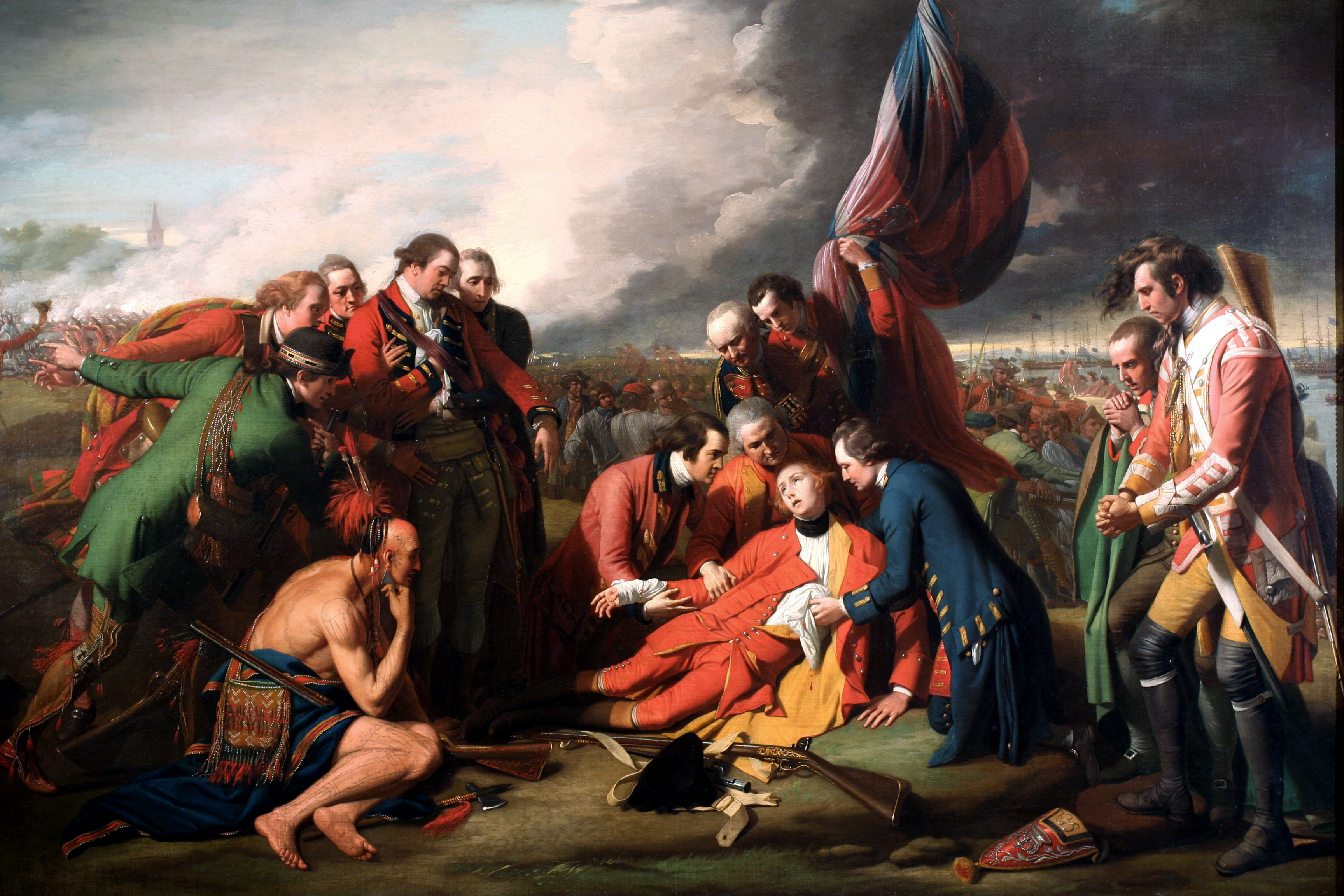
**Benjamin West's painting Death of General Wolfe is the first collectible picture in the album and has the following caption:
"General Wolfe's death in Quebec", a picture which has been reproduced countless times and is widespread not only in England, but also across the whole of Europe. The sentimental portrayal glorifies one of the most brutal violent actions of English history: the plundering of Canada.

,,General Wolfes Tod bei Quebec"
, ein Bild, das in unzähligen Wiedergaben nicht nur in England, sondern in ganz Europa verbreitet wurde, Die rührselige Darstellung verklärte eine der brutalsten Gewalttaten der englischen Geschichte: den Raub Kanadas."

Links
Here are a few resources on the history of cigarette card collecting in Germany:
  • http://www.germancards.com/GeneralStuff/germancards.htm
  • http://www.franklyncards.com/one/german.htm
  • http://en.wikipedia.org/wiki/Cigarette_card
And this is a list of other albums published by the Cigaretten-Bilderdienst: http://www.worldcat.org/identities/lccn-n79-106295

Tuesday, 24 March 2009

Schmidt: Lehrbuch der Englischen Sprache

Here's an English textbook I found on the "Kunstmarkt am 17. Juni" in Berlin. It's from 1905 and has some nice Jugendstil touches:


The first section of the book is a series of "lessons" to be used by teachers. It seems to be following a Berlitz-style approach; target language only, gestures and tone of voice used to convey meaning (so words are associated directly with concepts, not with first language translations), and intensive repetition of new vocabulary in different contexts and grammatical structures. As this explanation of the Berlitz Method puts it, "Teachers would have to constantly encourage students to speak the language being taught, employing a barrage of questions to be answered and a quickly expanding vocabulary. "

One thing I love about this book is the generous detail of the illustrations (although it's a shame more pages aren't illustrated). I find them far more appealing than the rough, cartoonish approach of many modern textbooks.


Further in, the book switches to more typical reading material for self-study. The texts cover the usual range of historical, political and cultural information but there are some surprises. I'm tempted to use this next page on my own classes, for a "guess the gadgets" activity:


Most helpfully of all are the model letters which could be copied and used in a wide variety of situations, from getting out of social engagements without causing offence, to putting tradespeople in their place:

Wednesday, 18 March 2009

"Pleasant English" for unpleasant times

This book needs no long preamble to make it sound interesting. It’s an English textbook for years 7 and 8 of the German Volksschule and it was published in 1939, shortly before the learners were officially at war with the subject matter.


Its condition suggests that it had a similar life history to most schoolbooks. A certain Fräulein Ingelore Giesecke carefully wrote her name in pencil on the inside cover before it fell victim to inkblots, a cracked spine and the violent loss of page 15. The inside pages aren’t dogeared or faded so Miss Giesecke may not have been the most enthusiastic of pupils.

That’s enough whimsical speculation about the owner, it’s the foreword which deserves our full attention. It’s aimed more at teachers than learners and explains how the various features of this book should be used in class. It explains that the exercises, which are provided after each chapter of reading material, are to be given as homework and so they don’t “release teachers from the duty” of finding other ways to practice in the classroom. It explains that a glossary is provided at the end of the book so that students don’t need to waste time looking through a dictionary, and also that the approach to grammar and speaking is functional rather than theoretical. In fact it says roughly the same as the foreword to every textbook I’ve ever taught from. The interesting part deals with the newly-written reading material:

The reading material serves to widen the sphere of experience from domestic life to life in the wider communities involved in day to day life and to the values which determine the behaviour of the Englishman towards these communities. In essence, these values bear a northern-germanic stamp and have enabled Englishmen to achieve great and awe-inspiring works; of which the formation of the British Empire constitutes the greatest. It is necessary that we Germans recognise and appreciate the real, inherent qualities of the English in order to be able to value them as political allies, or so as not to undervalue them as enemies.
However it is even more important that the young German is brought up to be proud of his own national identity and to have confidence in his position in relation to other peoples, so that he does not – as was previously the case, particularly in Hamburg – fall victim to an unworthy idolisation of all that is English. It is the task of English instruction to instill a worthy, self-assured attitude towards other peoples; with the rewriting of this reading material I hope to have given the teacher a useable basis for the fulfilment of this task.
Der Lesestoff bringt die Erweiterung des Erlebniskreises vom häuslichen Leben zum Leben in den größeren Gemeinschaften des täglichen Lebens und zu den Werten, die die Haltung des englischen Menschen diesen Gemeinschaften gegenüber bestimmen. Diese Werte sind im Wesentlichen nordlich-germanische Prägung und haben den englischen Menschen zu großen, achtungsgebietenden Leistungen befähigt, deren größte die Schaffung des britischen Weltreiches bildet. Es ist für und Deutsche nötig, die echten, artgebundenen Werte der Engländers zu kennen und zu achten, um ihn als politischen Freund schätzen zu können oder als Feind nicht zu unterschätzen. Noch wichtiger ist es allerdings, daß der junge deutsche Mensch zu Stolz auf sein eigenes Volkstum und zum Selbstbewußtsein anderen Völkern gegenüber erzogen wird, um nicht, wie das früher und besonders in Hamburg der Fall war, einer unwürdigen Vergötzung des Engländertums zu verfallen. Zu einer würdigen, selbstbewüßten Haltung gegenüber dem Fremdvolk zu erziehen, ist Aufgabe des englischen Unterrichts; mit der Neugestaltung des Lesestoffes hoffe ich dem Lehrer eine brauchbare Grundlage für diese Erziehungsarbeit gegeben zu haben.

Task 1: Compare and contrast these stated aims with the assertions of schoolteacher Agnes Pernitz.

The book contains eighteen chapters, covering largely the same topics as English Life and Thought but from the point of view of a German family, the Petersens, who have moved to England. The two children, Peter and Katie, have things explained to them by various adults and friends, and come across as fairly stupid as a result. There’s information about life at an English school, sights in London, Christmas traditions (no Santa in Germany), typical suburban homes...

...London landmarks...

...and so on and, like with English Life and Thought, some parts are very much of their time. For example, when Peter tells his friend Morris that he will be joining his school, the exchange runs:

“Here is a piece of news for you. I am coming into your class,” said Peter.
“Cheers,” cried Morris, “We shall have great sport.” (p.49)
Although that’s nowhere near as dated as this incident on a day trip to the zoo:
When they came near the elephants, Katie gave a shriek.
“Negroes,” she cried, pointing at two coloured men who were in charge of the elephants. Peter laughed at her, for they were not Negroes, but Hindoos. (p.19)
The grammar exercise which follows their trip to the zoo is also not really suitable for the modern English class:


Then there are the parts which live up to the aims of the foreword. I’ll start off with a fairly mild one, in which Kate asks her teacher about British coins:
“All lawful coins of Great Britain and Northern Ireland are called Sterling which means “good”. And as a little German you may be interested to hear that this word is a compliment to your forefathers. As a matter of fact, early Saxon traders who came to this country from the East, that is to say from Germany, and who, therefore, were called Easterlings, introduced silver coins which were better than any other silver coins. They were honest tradesmen and the English people trusted their money more than anybody else’s and therefore all good money is called Sterling. You must feel proud of this fact, I am sure.”
Kate was a little confused about all she had heard, but, nevertheless, she did feel proud of her forefathers and grateful to Miss Allen for this explanation. (p.56)
As indeed all small children are when a simple question like “Why do you write d for penny?” is answered with a lecture on ancient history.

The Easterling Theory seems to have been around for a good while (at least according to the Wikipedia entry for Sterling Silver), with 'Easterlings' referring to the 12th century Hanseatic League. More on their importance for German nationalist historians when I finally finish some translations from Raubstaat England.

The next extract is from the chapter “Modern Youth”.
Peter explained to Morris that some of his comrades had been sent to Nuremberg during the Party Rally. They were to take part in the displays of the Hitler Youth Movement.
[...]
The envelope contained a number of snapshots which one of Peter’s comrades had taken on their march to Nuremberg.
“This is my patrol-leader,” said Peter. “Lucky fellow to be sent there. He is a decent chap, though.”
“They must have had a hard time to walk all that way from Hamburg to Nuremberg,” replied Morris.
“I should not have minded walking,” continued Peter. “Most of us are good walkers, and I like walking very much. By the way, we are trained to exert ourselves, and this march to Nuremberg is a glorious test of what we can do.”
Morris was interested in the uniform and at last asked Peter if he had his uniform with him. Then Peter took Morris to his room, put on his uniform and told Morris about camping, sports, and other activities and entertainments.
[...]
“Well,” said Morris at last. “I am going to be a Scout. Mr.Henderson, our gym-master, is a Scoutmaster. He has asked me to join the Scouts. But first I have to be a Tenderfoot. Then I shall have to pass an examination, and after that I’ll become a second-class Scout. It will be great fun, I am sure.”
[...]
“I wanted to be a Wolf Cub long ago,” he continued. “Dad said he did not mind. But my mother would not let me. She is always afraid that I may catch a cold. But Mr.Henderson persuaded her to give her permission.” (67-8)
And now for the world domination bit. Morris and Peter’s teacher is demonstrating the range of the British Empire using a globe (mentioning a few German colonies in passing, all of which are explained in footnotes. France doesn’t get a mention, naturally). How does our Average German Kid react to this geography lesson?
Peter was deeply impressed. But at the same time he was thinking of what the Fuehrer had said about the ‘haves’ and the ‘have-nots’ and saying to himself: “Well, one day we’ll have colonies of our own again, after all.” But he did not say anything about what he was thinking, not even to Morris. He had already learnt to keep his tongue and leave things to those responsible for his country’s welfare.(p.76-7)
This section is followed by a list of “countries and their inhabitants”, including “The Sudetenland”, which is inhabited by “The Sudeten Germans” (and no-one else, apparently).

None of the things I've mentioned so far provoked any emotions in me other than mild amusement at an obsolete view of the world and relief that we've put so much distance between then and now. With the benefit of hindsight however, the last chapter is more than a little poignant. The title of the chapter is “Hero-worship” and the two boys are visiting the Cenotaph in London. It struck me as quite ironic that such an idealised view of integration and multi-culturalism can be combined with references to trench warfare and the Hitler Salute:
Every man who passed on foot, in bus or car, raised his hat, and ladies bowed their heads as they passed the Cenotaph.
Peter was reminded of a similar scene which he had witnessed in Munich when he passed the Feldherrnhalle with his parents and every passer-by raised his arm to greet the Dead of the 9th of November.
77. the boys had stepped on in silence. After a while Morris broke the silence:
“One day I’ll take you to Westminster Abbey where the ‘Unknown Soldier’ is buried.”
Peter did not answer. He was thinking of his uncle who had been killed by an English shell in Flanders and whose body had never been found.
Morris felt that something had risen between them. At last Morris said: “I know, Peter, what you are thinking. You are German, and I am English. We both love our country and worship our heroes. That is no reason why we should not be friends.
[...] We are taught that England expects every man to do his duty, and I suppose you have similar sayings. But I do know that I could not be friends with a boy who is not willing to live up to what the Great Men of his country died for. I hope we shall always remain friends.”
Peter made no reply at first. He just caught Morris’s hand, and said: “Yes, William.” When they parted that night, they felt as they shook hands, that their friendship had strengthened. But they also felt that they were not mere individuals, but members of two great nations.

It's poignant because here we have two boys - fictional but with many real-life counterparts - admirably pledging to remain friends against the odds. The German boy has made every effort to integrate and the English have placed no unreasonable demands upon him. He can be German as well as a member of English society. The boys haven't forgotten the past, nor do they allow themselves to be unfairly constrained by it. They represent healthy skin covering the scars of the First World War, about to be ripped open again by the Second. Whether they survive or not, their friendship almost certainly won't.

The core material of the textbook is followed by a very strange assortment of supplementary texts: songs, poems, Christmas stories and a Punch and Judy script. There's a 25-page glossary at the back, organised according to chapter. There's also 25 pages of grammar notes, including the best diagram for English tenses of any textbook I've ever seen. You can take your 2-D timelines for a short walk off a long pier: