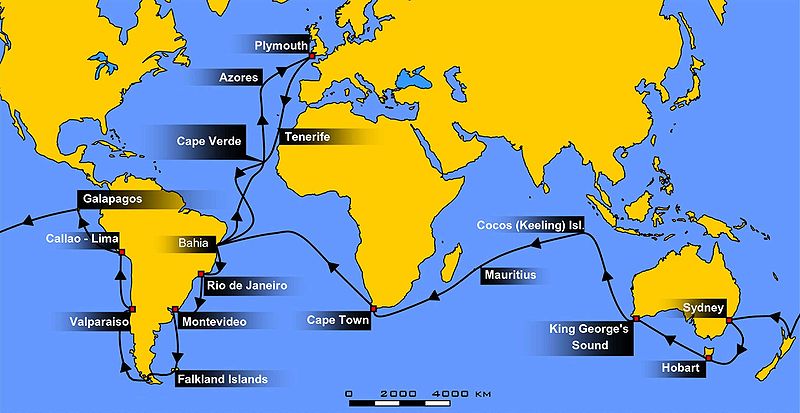
I've been reading The Voyage of the Beagle, the account of his travels which rightly brought Charles Darwin fame and praise as a writer as well as a naturalist. He wrote for a non-specialist readership, but it's still not exactly light reading. It has however given me a completely different view of a man whom I usually picture sitting quietly in a Victorian study, peering at fossils over his enormous white beard. All the passages below are from 1832, when the Beagle was surveying the Eastern coast of South America, and due to the way he groups his observations, the locations given aren't always related to the events. Here he is, in the fine tradition of English tourists, failing to master an important local skill:
Entry from July 26th, travelling inland from Maldonado, Uruguay
The main difficulty in using either lazo or bolas is to ride so well as to be able at full speed, and while suddenly turning about, to whirl them so steadily round the head, as to take aim: on foot any person would soon learn the art. One day, as I was amusing myself by galloping and whirling the balls round my head, by accident the free one struck a bush, and its revolving motion being thus destroyed, it immediately fell to the ground, and, like magic, caught one hind leg of my horse; the other ball was then jerked out of my hand, and the horse fairly secured. Luckily he was an old practised animal, and knew what it meant; otherwise he would probably have kicked till he had thrown himself down. The Gauchos roared with laughter; they cried out that they had seen every sort of animal caught, but had never before seen a man caught by himself.As well as the fish-out-of-water humour, Darwin gives his readers an insight into the sheer joy of discovery.
Entry from April 19th
During the remainder of my stay at Rio, I resided in a cottage at Botofogo Bay. It was impossible to wish for anything more delightful than thus to spend some weeks in so magnificent a country. In England any person fond of natural history enjoys in his walks a great advantage, by always having something to attract his attention; but in these fertile climates, teeming with life, the attractions are so numerous, that he is scarcely able to walk at all.July 5th, travelling from Rio de Janeiro to Montevideo
[...]
Nature, in these climes, chooses her vocalists from more humble performers than in Europe. A small frog, of the genus Hyla, sits on a blade of grass about an inch above the surface of the water, and sends forth a pleasing chirp: when several are together they sing in harmony on different notes. I had some difficulty in catching a specimen of this frog. The genus Hyla has its toes terminated by small suckers; and I found this animal could crawl up a pane of glass, when placed absolutely perpendicular. Various cicidae and crickets, at the same time, keep up a ceaseless shrill cry, but which, softened by the distance, is not unpleasant. Every evening after dark this great concert commenced; and often have I sat listening to it, until my attention has been drawn away by some curious passing insect.
As soon as we entered the estuary of the Plata, the weather was very unsettled. One dark night we were surrounded by numerous seals and penguins, which made such strange noises, that the officer on watch reported he could hear the cattle bellowing on shore. On a second night we witnessed a splendid scene of natural fireworks; the mast-head and yard-arm-ends shone with St. Elmo's light; and the form of the vane could almost be traced, as if it had been rubbed with phosphorus. The sea was so highly luminous, that the tracks of the penguins were marked by a fiery wake, and the darkness of the sky was momentarily illuminated by the most vivid lightning.It isn't all pleasant reading, of course. His views on slavery are frustrating: humanity and self-awareness when describing personal interactions, but a general unwillingness to condemn the system.
April 13th, on an estate called Socego, Brazil
One morning I walked out an hour before daylight to admire the solemn stillness of the scene; at last, the silence was broken by the morning hymn, raised on high by the whole body of the blacks; and in this manner their daily work is generally begun. On such fazendas as these, I have no doubt the slaves pass happy and contented lives. On Saturday and Sunday they work for themselves, and in this fertile climate the labour of two days is sufficient to support a man and his family for the whole week.April 14th, having travelled to "another estate on the Rio Macae"
While staying at this estate, I was very nearly being an eye-witness to one of those atrocious acts which can only take place in a slave country. Owing to a quarrel and a lawsuit, the owner was on the point of taking all the women and children from the male slaves, and selling them separately at the public auction at Rio. Interest, and not any feeling of compassion, prevented this act. Indeed, I do not believe the inhumanity of separating thirty families, who had lived together for many years, even occurred to the owner. Yet I will pledge myself, that in humanity and good feeling he was superior to the common run of men. It may be said there exists no limit to the blindness of interest and selfish habit. I may mention one very trifling anecdote, which at the time struck me more forcibly than any story of cruelty. I was crossing a ferry with a negro, who was uncommonly stupid. In endeavouring to make him understand, I talked loud, and made signs, in doing which I passed my hand near his face. He, I suppose, thought I was in a passion, and was going to strike him; for instantly, with a frightened look and half-shut eyes, he dropped his hands. I shall never forget my feelings of surprise, disgust, and shame, at seeing a great powerful man afraid even to ward off a blow, directed, as he thought, at his face. This man had been trained to a degradation lower than the slavery of the most helpless animal.There's a useful-looking map of the voyage here.