What's all this then?


My name is Victoria Stiles and I'm an Early Career Historian currently doing whatever odd research / consulting / outreach / tutoring jobs come my way. I blog here about some of the interesting texts I've found.
My research focusses on books about Britain and the British Empire which were in circulation in Nazi Germany but you'll also find a smattering of school textbooks, witchcraft beliefs, bog drainage, bemused travellers and weird illustrations that caught my eye.
Translations from German are my own. Comments are currently unmoderated and are mostly spam for leather jackets anyway.

Friday, 22 May 2009

England: The Robber State (I)

I first came across Raubstaat England (England the Robber State) at a fleamarket a few months ago (and blogged about here). I managed to persuade myself that 40 Euros was too much to pay for 1941 cigarette card album but put up far less of a fight when I found it in a shop for 3/4 of the price.
Unlike typical British and American albums, most of the space is given over to text, making it more like a history book with the illustrations removed. It is, however, a history book with a very clear aim. Here are the front and inside covers:


The introductory chapter to Raubstaat England is called ,,Vorkämpfer der Freiheit" (champions of freedom). The title is in quote marks although there's no indication of who might have said this, or if it's a view attributed to a whole group of people. It's amazing how punctuation can indicate so much sometimes. The author (Dr E. Lewalter) starts with a description of his first English lessons, shortly after the turn of the century, in which he and his classmates were taught to recite a sea-shanty. Firstly, a bit of a dig at the unfamiliar pronunciation:
"[...] with amazement we became aware of which contortions the human speech apparatus, and of which uncleanliness the voicebox must be capable of, in order to bring forth truly English sounds."

(,,[...]wir wurden mit Staunen gewahr, welcher Verrenkungen die menschlichen Sprechwerkzeuge, welcher Unreinlichkeiten die Muskulaturen des Kehlkopfes fähig sein mußten, um echt englisch klingende Laute hervorzubringen.")
Eventually the class are trusted to recite the full sea shanty in chorus, pre-pubescent voices escaping through the open classroom window to declare triumphantly to the world:
"And 't is our endeavour
In battle and in breeze
That England shall ever
Be Lord of the seas."
I agree with the author that this is a slightly dubious thing for German children to be memorising and chanting in the middle of an Anglo-German arms race. On the other hand, he has beefed up the militarism in his translation:
,,Ob Schlachten toben,
Ob Stürme dräun,
England muß Herrin
Der Meere sein."
which, brought back into English, goes something like: "Whether battles rage or storms threaten, England must be ruler of the seas". This rather unfairly changes the song from one of ambition to one of jealous protection of superiority, which nicely sets up the central message of the book.*

Lewalter wonders why nobody worried about Germany's youth, even after World War One, being taught using such anglophile material, which he feels must have led to a creeping sense of awe regarding England's naval power. Apparently the rest of his old textbook failed to provide balance and consisted of moving and edifying texts on, for example, the death of General Wolfe**, the Battle of Blenheim (with no mention of Prince Eugene), and all manner of English victories, including against the Scots and the Irish.
Two impressions arose through exposure to this material:
1. that the English always had right, and therefore the sympathies of the young German reader, on their side.
2. that the English had always been friends and allies of the Germans; their "cousins across the Channel" (,,Vettern jenseits des Kanals")
So where is he going with all this?
"However different the experiences of individual youths may have been, taken as a whole one is able to say that the German youth before the world war was raised in a strange, almost resigned reverence towards England - to be followed by a harsh awakening when England allied herself with our enemies right at the start of the world war."

,,Mögen solche Jugenderlebnisse auch im einzelnen recht verschieden gewesen sein, im ganzen wird man sagen dürfen, daß die deutsche Jugend vor dem Weltkriege in einer seltsamen, fast resignierenden Englandfrömmigkeit auferzogen wurde - aus der dann ein böses Erwachen folgte, als England sich gleich zu Beginn des Weltkrieges auf die Seite unserer Feinde stellte."
Lewalter makes it clear that this attitude only applied to England and that it would be unthinkable, especially after the war of 1870, for French grammar textbooks to contain texts glorifying French imperialism. He admits that German sympathies for the Boers during the Boer War "cast a threatening shadow over Anglo-German relations" (,,einen bedrohlichen Schatten auf die deutsch-englischen Beziehungen geworfen") but this was not seen as grounds to change the way in which Germany's youth were taught.

Without knowing which textbook was inflicted upon the author and his classmates, it is impossible to judge whether his assertions are accurate or exaggerated. None of the pre-1914 English textbooks I have found so far deal so thoroughly with England's military history. However, the re-use of texts by English authors seems to have been common (quicker, easier, more authentic and no doubt cheaper than having German authors write sample texts from scratch) and the chosen texts were never intended to provide a balanced view of history, but to serve as interesting reading exercises. Also, this problem hadn't gone completely unnoticed before the 1940s, as shown by the foreword to the 1939 rewrite of Pleasant English II.

So that's brought us to the beginning of page two. The other 128 pages will have to wait.


*Interestingly enough, a similar process - that of interpreting a patriotic song as having an overly aggressive, expansionist message - has also been carried out on the German national anthem.
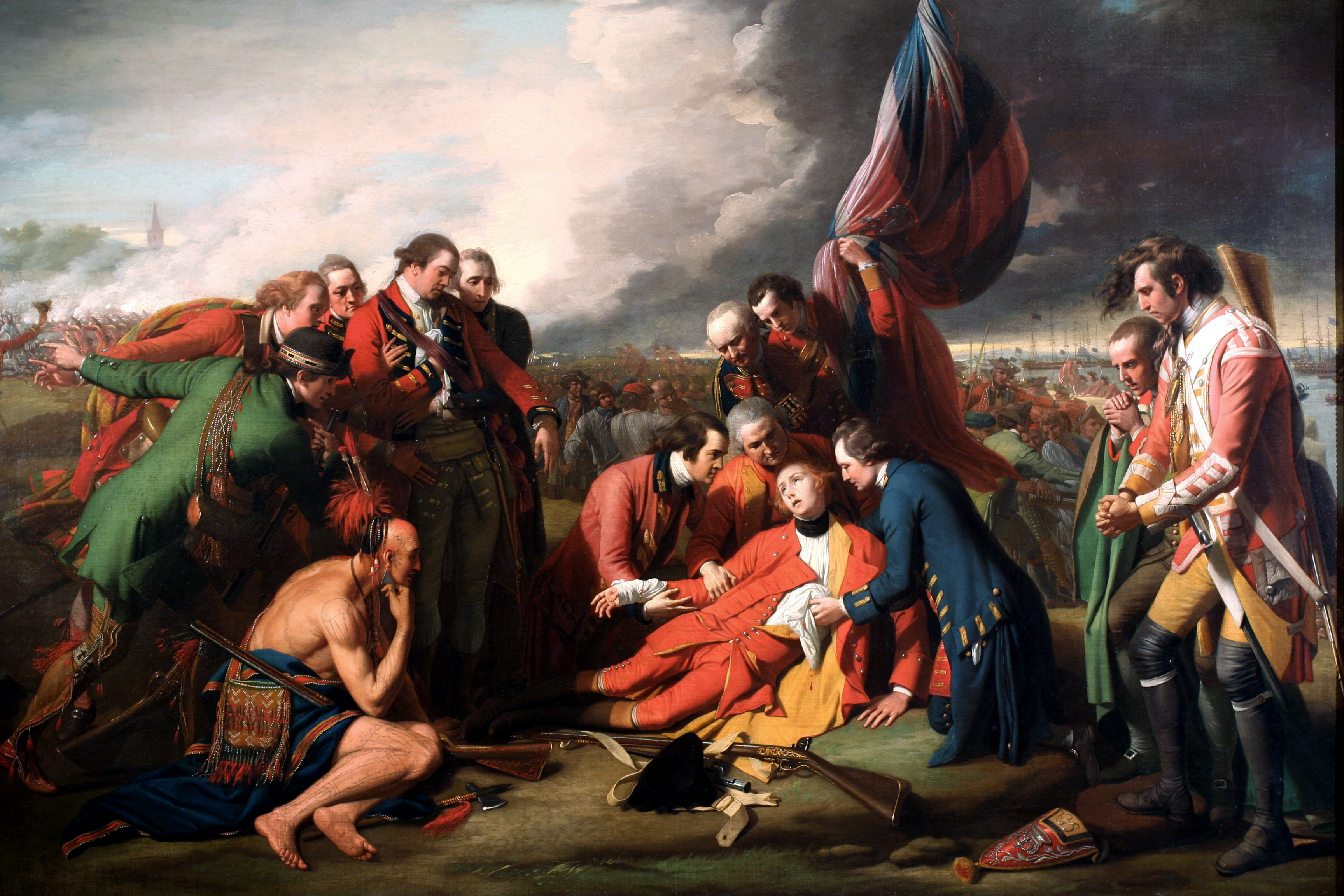

**Benjamin West's painting Death of General Wolfe is the first collectible picture in the album and has the following caption:
"General Wolfe's death in Quebec", a picture which has been reproduced countless times and is widespread not only in England, but also across the whole of Europe. The sentimental portrayal glorifies one of the most brutal violent actions of English history: the plundering of Canada.

,,General Wolfes Tod bei Quebec"
, ein Bild, das in unzähligen Wiedergaben nicht nur in England, sondern in ganz Europa verbreitet wurde, Die rührselige Darstellung verklärte eine der brutalsten Gewalttaten der englischen Geschichte: den Raub Kanadas."

Links
Here are a few resources on the history of cigarette card collecting in Germany:
  • http://www.germancards.com/GeneralStuff/germancards.htm
  • http://www.franklyncards.com/one/german.htm
  • http://en.wikipedia.org/wiki/Cigarette_card
And this is a list of other albums published by the Cigaretten-Bilderdienst: http://www.worldcat.org/identities/lccn-n79-106295

Tuesday, 24 March 2009

Schmidt: Lehrbuch der Englischen Sprache

Here's an English textbook I found on the "Kunstmarkt am 17. Juni" in Berlin. It's from 1905 and has some nice Jugendstil touches:


The first section of the book is a series of "lessons" to be used by teachers. It seems to be following a Berlitz-style approach; target language only, gestures and tone of voice used to convey meaning (so words are associated directly with concepts, not with first language translations), and intensive repetition of new vocabulary in different contexts and grammatical structures. As this explanation of the Berlitz Method puts it, "Teachers would have to constantly encourage students to speak the language being taught, employing a barrage of questions to be answered and a quickly expanding vocabulary. "

One thing I love about this book is the generous detail of the illustrations (although it's a shame more pages aren't illustrated). I find them far more appealing than the rough, cartoonish approach of many modern textbooks.


Further in, the book switches to more typical reading material for self-study. The texts cover the usual range of historical, political and cultural information but there are some surprises. I'm tempted to use this next page on my own classes, for a "guess the gadgets" activity:


Most helpfully of all are the model letters which could be copied and used in a wide variety of situations, from getting out of social engagements without causing offence, to putting tradespeople in their place:

Wednesday, 18 March 2009

"Pleasant English" for unpleasant times

This book needs no long preamble to make it sound interesting. It’s an English textbook for years 7 and 8 of the German Volksschule and it was published in 1939, shortly before the learners were officially at war with the subject matter.


Its condition suggests that it had a similar life history to most schoolbooks. A certain Fräulein Ingelore Giesecke carefully wrote her name in pencil on the inside cover before it fell victim to inkblots, a cracked spine and the violent loss of page 15. The inside pages aren’t dogeared or faded so Miss Giesecke may not have been the most enthusiastic of pupils.

That’s enough whimsical speculation about the owner, it’s the foreword which deserves our full attention. It’s aimed more at teachers than learners and explains how the various features of this book should be used in class. It explains that the exercises, which are provided after each chapter of reading material, are to be given as homework and so they don’t “release teachers from the duty” of finding other ways to practice in the classroom. It explains that a glossary is provided at the end of the book so that students don’t need to waste time looking through a dictionary, and also that the approach to grammar and speaking is functional rather than theoretical. In fact it says roughly the same as the foreword to every textbook I’ve ever taught from. The interesting part deals with the newly-written reading material:

The reading material serves to widen the sphere of experience from domestic life to life in the wider communities involved in day to day life and to the values which determine the behaviour of the Englishman towards these communities. In essence, these values bear a northern-germanic stamp and have enabled Englishmen to achieve great and awe-inspiring works; of which the formation of the British Empire constitutes the greatest. It is necessary that we Germans recognise and appreciate the real, inherent qualities of the English in order to be able to value them as political allies, or so as not to undervalue them as enemies.
However it is even more important that the young German is brought up to be proud of his own national identity and to have confidence in his position in relation to other peoples, so that he does not – as was previously the case, particularly in Hamburg – fall victim to an unworthy idolisation of all that is English. It is the task of English instruction to instill a worthy, self-assured attitude towards other peoples; with the rewriting of this reading material I hope to have given the teacher a useable basis for the fulfilment of this task.
Der Lesestoff bringt die Erweiterung des Erlebniskreises vom häuslichen Leben zum Leben in den größeren Gemeinschaften des täglichen Lebens und zu den Werten, die die Haltung des englischen Menschen diesen Gemeinschaften gegenüber bestimmen. Diese Werte sind im Wesentlichen nordlich-germanische Prägung und haben den englischen Menschen zu großen, achtungsgebietenden Leistungen befähigt, deren größte die Schaffung des britischen Weltreiches bildet. Es ist für und Deutsche nötig, die echten, artgebundenen Werte der Engländers zu kennen und zu achten, um ihn als politischen Freund schätzen zu können oder als Feind nicht zu unterschätzen. Noch wichtiger ist es allerdings, daß der junge deutsche Mensch zu Stolz auf sein eigenes Volkstum und zum Selbstbewußtsein anderen Völkern gegenüber erzogen wird, um nicht, wie das früher und besonders in Hamburg der Fall war, einer unwürdigen Vergötzung des Engländertums zu verfallen. Zu einer würdigen, selbstbewüßten Haltung gegenüber dem Fremdvolk zu erziehen, ist Aufgabe des englischen Unterrichts; mit der Neugestaltung des Lesestoffes hoffe ich dem Lehrer eine brauchbare Grundlage für diese Erziehungsarbeit gegeben zu haben.

Task 1: Compare and contrast these stated aims with the assertions of schoolteacher Agnes Pernitz.

The book contains eighteen chapters, covering largely the same topics as English Life and Thought but from the point of view of a German family, the Petersens, who have moved to England. The two children, Peter and Katie, have things explained to them by various adults and friends, and come across as fairly stupid as a result. There’s information about life at an English school, sights in London, Christmas traditions (no Santa in Germany), typical suburban homes...

...London landmarks...

...and so on and, like with English Life and Thought, some parts are very much of their time. For example, when Peter tells his friend Morris that he will be joining his school, the exchange runs:

“Here is a piece of news for you. I am coming into your class,” said Peter.
“Cheers,” cried Morris, “We shall have great sport.” (p.49)
Although that’s nowhere near as dated as this incident on a day trip to the zoo:
When they came near the elephants, Katie gave a shriek.
“Negroes,” she cried, pointing at two coloured men who were in charge of the elephants. Peter laughed at her, for they were not Negroes, but Hindoos. (p.19)
The grammar exercise which follows their trip to the zoo is also not really suitable for the modern English class:


Then there are the parts which live up to the aims of the foreword. I’ll start off with a fairly mild one, in which Kate asks her teacher about British coins:
“All lawful coins of Great Britain and Northern Ireland are called Sterling which means “good”. And as a little German you may be interested to hear that this word is a compliment to your forefathers. As a matter of fact, early Saxon traders who came to this country from the East, that is to say from Germany, and who, therefore, were called Easterlings, introduced silver coins which were better than any other silver coins. They were honest tradesmen and the English people trusted their money more than anybody else’s and therefore all good money is called Sterling. You must feel proud of this fact, I am sure.”
Kate was a little confused about all she had heard, but, nevertheless, she did feel proud of her forefathers and grateful to Miss Allen for this explanation. (p.56)
As indeed all small children are when a simple question like “Why do you write d for penny?” is answered with a lecture on ancient history.

The Easterling Theory seems to have been around for a good while (at least according to the Wikipedia entry for Sterling Silver), with 'Easterlings' referring to the 12th century Hanseatic League. More on their importance for German nationalist historians when I finally finish some translations from Raubstaat England.

The next extract is from the chapter “Modern Youth”.
Peter explained to Morris that some of his comrades had been sent to Nuremberg during the Party Rally. They were to take part in the displays of the Hitler Youth Movement.
[...]
The envelope contained a number of snapshots which one of Peter’s comrades had taken on their march to Nuremberg.
“This is my patrol-leader,” said Peter. “Lucky fellow to be sent there. He is a decent chap, though.”
“They must have had a hard time to walk all that way from Hamburg to Nuremberg,” replied Morris.
“I should not have minded walking,” continued Peter. “Most of us are good walkers, and I like walking very much. By the way, we are trained to exert ourselves, and this march to Nuremberg is a glorious test of what we can do.”
Morris was interested in the uniform and at last asked Peter if he had his uniform with him. Then Peter took Morris to his room, put on his uniform and told Morris about camping, sports, and other activities and entertainments.
[...]
“Well,” said Morris at last. “I am going to be a Scout. Mr.Henderson, our gym-master, is a Scoutmaster. He has asked me to join the Scouts. But first I have to be a Tenderfoot. Then I shall have to pass an examination, and after that I’ll become a second-class Scout. It will be great fun, I am sure.”
[...]
“I wanted to be a Wolf Cub long ago,” he continued. “Dad said he did not mind. But my mother would not let me. She is always afraid that I may catch a cold. But Mr.Henderson persuaded her to give her permission.” (67-8)
And now for the world domination bit. Morris and Peter’s teacher is demonstrating the range of the British Empire using a globe (mentioning a few German colonies in passing, all of which are explained in footnotes. France doesn’t get a mention, naturally). How does our Average German Kid react to this geography lesson?
Peter was deeply impressed. But at the same time he was thinking of what the Fuehrer had said about the ‘haves’ and the ‘have-nots’ and saying to himself: “Well, one day we’ll have colonies of our own again, after all.” But he did not say anything about what he was thinking, not even to Morris. He had already learnt to keep his tongue and leave things to those responsible for his country’s welfare.(p.76-7)
This section is followed by a list of “countries and their inhabitants”, including “The Sudetenland”, which is inhabited by “The Sudeten Germans” (and no-one else, apparently).

None of the things I've mentioned so far provoked any emotions in me other than mild amusement at an obsolete view of the world and relief that we've put so much distance between then and now. With the benefit of hindsight however, the last chapter is more than a little poignant. The title of the chapter is “Hero-worship” and the two boys are visiting the Cenotaph in London. It struck me as quite ironic that such an idealised view of integration and multi-culturalism can be combined with references to trench warfare and the Hitler Salute:
Every man who passed on foot, in bus or car, raised his hat, and ladies bowed their heads as they passed the Cenotaph.
Peter was reminded of a similar scene which he had witnessed in Munich when he passed the Feldherrnhalle with his parents and every passer-by raised his arm to greet the Dead of the 9th of November.
77. the boys had stepped on in silence. After a while Morris broke the silence:
“One day I’ll take you to Westminster Abbey where the ‘Unknown Soldier’ is buried.”
Peter did not answer. He was thinking of his uncle who had been killed by an English shell in Flanders and whose body had never been found.
Morris felt that something had risen between them. At last Morris said: “I know, Peter, what you are thinking. You are German, and I am English. We both love our country and worship our heroes. That is no reason why we should not be friends.
[...] We are taught that England expects every man to do his duty, and I suppose you have similar sayings. But I do know that I could not be friends with a boy who is not willing to live up to what the Great Men of his country died for. I hope we shall always remain friends.”
Peter made no reply at first. He just caught Morris’s hand, and said: “Yes, William.” When they parted that night, they felt as they shook hands, that their friendship had strengthened. But they also felt that they were not mere individuals, but members of two great nations.

It's poignant because here we have two boys - fictional but with many real-life counterparts - admirably pledging to remain friends against the odds. The German boy has made every effort to integrate and the English have placed no unreasonable demands upon him. He can be German as well as a member of English society. The boys haven't forgotten the past, nor do they allow themselves to be unfairly constrained by it. They represent healthy skin covering the scars of the First World War, about to be ripped open again by the Second. Whether they survive or not, their friendship almost certainly won't.

The core material of the textbook is followed by a very strange assortment of supplementary texts: songs, poems, Christmas stories and a Punch and Judy script. There's a 25-page glossary at the back, organised according to chapter. There's also 25 pages of grammar notes, including the best diagram for English tenses of any textbook I've ever seen. You can take your 2-D timelines for a short walk off a long pier: