What's all this then?


My name is Victoria Stiles and I'm an Early Career Historian currently doing whatever odd research / consulting / outreach / tutoring jobs come my way. I blog here about some of the interesting texts I've found.
My research focusses on books about Britain and the British Empire which were in circulation in Nazi Germany but you'll also find a smattering of school textbooks, witchcraft beliefs, bog drainage, bemused travellers and weird illustrations that caught my eye.
Translations from German are my own. Comments are currently unmoderated and are mostly spam for leather jackets anyway.

Saturday, 4 February 2012

Hitler wasn't racist either, but...

Having written a bit about the problems of "trivialising" the Nazis last time, I hope I'm not going to come across as too flippant here. On the other hand, I didn't want to shy away from quoting Adolf Hitler directly*, as it's important to know what he said and what effect this might have had on his audience, rather than treating his words as though they'll conjure up demons. I'm not particularly satisfied with this translation, and have included the original at the end of this post for easy reference.

Although I found in difficult to render the crucial sentence (here in bold) in English, I was struck by how similar it is to sentiments expressed quite freely in Britain today; that there is nothing wrong with other races and cultures, but that they should exist seperately and the culture and rules of one should not be forced upon another. In this case, parallels are being drawn between British rule in India and Jewish "imperialism" in Germany. Nowadays, the fact that the European way of doing things was being exported long before the (alleged) attempted introduction of, for example, Sharia Law to European countries, tends to be ignored.
Our attitude towards other races is that of objective disinterest. Just as with the Indian people, the German people is made up of several races and tribes. The Indian people, with its four-thousand-year-old culture, has developed its own racial laws, which cannot easily be translated into a European context. Dr. Goebbels is quite right to say that it is incorrect to speak of races of lesser value. No race is inherently inferior to another; at most, the different races which populate the earth are of differing value. This applies also to the Jewish race. The Jew is not inherently inferior within his own environment, but his outlook is not a good fit for the German people, and can in fact be damaging. For that reason, the Jews must endeavour to live as a separate people. Each race must find within themselves their own world and this is why we are quite right to defend ourselves against another race's attempts to force their peculiarities upon us, as the Jews have done in Germany.
What I want to get across here is that fact that almost nobody wants to admit to being racist. Everyone knows that racism is unacceptable. However, there are many ways to twist the definition of racism so that it happens to exclude the views that you hold and the policies you are advocating. This goes for people even as unashamedly racist as the leaders of the Nazi party, if they were called upon to account for their views: they had nothing against other races, you understand, they merely recognised that different races have different strengths and weaknesses, and will thrive better in their own habitat. They were worried that combining more than one in the same place would inevitably cause damage. Every race has the right to an area which belongs only to them and not to have alien laws and habits forced upon them. If a race such as the Jews have no place where they belong then one can be found for them but really this is their responsibility. And, partly for their own good, they can't be allowed to take up space which belongs to another race. Of course they have nothing but our good wishes, so long as they conform to this natural order, but due to the difficulties involved and their unwillingness to cooperate then if they were to... disappear from this scheme it would greatly benefit the world in years to come. But none of this is "racist"; it's just recognising the nature of things. See?

There are very few self-confessed racists in the world, BUT... people still die purely because they are considered to belong to the wrong race for the bit of earth they're standing on. That fact should be what we reach for, when getting lost among the excuses.

*These words are from official notes taken of an interview between Hitler and Indian journalist Dr. Sinha, 6th December 1935. They are quoted in an article by Johannes H. Voigt: 'Hitler und Indien' in Vierteljahreshefte für Zeitgeschichte, vol. 19/1 (Jan. 1971) pp.33-63. It is not clear how accurately they record Hitler's specific phrasing.

"Unsere Einstellung zu anderen Rassen sei die einer objektiven Desinteressiertheit. Genau wie das indische setze sich auch das deutsche Volk aus mehreren Rassen und Stammen zusammen. Das indische Volk mit seiner vieltausendjährigen Kultur habe sich eigene Rassengesetze gegeben, die auch nicht ohne weiteres auf europäsche Verhältnisse zu übertragen seien. Dr. Goebbels habe ganz recht, wenn er es als unrichtig bezeichne, von minderwertigen Rassen zu sprechen. Keine Rasse sei an sich minderwertig; die verschiedenen Rassen, die die Erde bevölkern, seien höchstens untereinander anderswertig. Das gelte auch für die jüdische Rasse. Der Jude sei an sich nicht minderwertig in seinen Anlagen, aber seine Auffassungen paßten nicht für das deutsche Volk, sie seien vielmehr geradezu schadlich, und deswegen müsse der Jude dafür sorgen, daß er für sich allein als Volk leben könne. Jede Rasse müsse ihre Welt in sich finden, und darum wehrten wir uns mit Recht dagegen, daß uns eine andere Rasse ihre Eigentümlichkeiten aufzuzwingen suche, wie es die Juden in Deutschland getan hatten."

Friday, 27 January 2012

Holocaust Memorial Day: Thoughts and Complications

I wasn't going to write anything in particular for today because this isn't something I find easy to put into words in a little white box on my computer screen. It's on the one hand too complex a topic to say anything concrete about it at all (we still don't know, as an indisputable historical fact, how many people died, how, and on precisely whose orders*) but on the other hand it can be summed up quite simply: long-running prejudices, left largely unchallenged, led to the systematic murder of millions of people. However, living in Germany and studying Nazi cultural history means I think about this a lot and in connection with many other topics, and I might as well commit some of those thoughts to paper.
  • The Holocaust is not just Nazi history and Nazi history is not just the Holocaust; although neither can you extract one from the other. An accusation often more of less explicitly levelled at historians of "every-day life" in the Third Reich is that we (I guess I'm one of them too) are "trivialising" the Nazis, particularly when trying to trace broader continuities in cultural history. By looking at what people read or cooked or how they spent their days off, we're reducing the crucial question of "how could such evil have come about?" to just one of many sideshows. The counter-accusation is that of fetishising the Holocaust; by studying it only in a certain way, sealed off from other historical currents, we run the risk of draining it of all real meaning. Detaching the events from the physical and cultural worlds in which they took place - denying that they were a product of normal humans, and normal political processes - is to make them intangible and incomprehensible.
  • Related to this is the issue of "learning the lesson", of "never forgetting" and of "the message". If you ask someone what that message is, they will probably say something along to lines of "never again". Probe any deeper, and everything suddenly falls apart. What shouldn't we do again? Give governments control over life and death? Allow them to remove people from next door without paying attention to where they're going? Happily let much of the popular press print story after story, systematically demonising a particular religion or minority group? Vote for a man with a small moustache?
  • Sometimes, it seems that the main "lesson" to be learned is not to dress up in Nazi uniform or have any kind of fun while invoking that particular set of shared associations. I agree with Jennifer Lipman (who wrote this in the Telegraph today) that it would be nicer all round if people didn't do that kind of thing, and that it is a probable indication of a general lack of awareness. However, returning to my first point, the Nazis were not *only* mass-murderers. As a group they were also self-important, deluded, frustrated, crowing, bullying, pathetic... humans. They built themselves up as something greater than everything that had gone before and as the fathers (and mothers) of a new, better world order but, in the end, they were wrong and they were human. They deserve ridicule, not that hushed, fearful awe which so easily morphs into respect. The more people making fun of the mere idea of them, the more they can be kept spinning in their graves, and the less easy it is for groups wanting to emulate them to gain any kind of traction**. I'm not worried about people playing Nazi-themed games on a skiing holiday. I'm worried about people very carefully planning to plant home-made bombs in areas with high immigrant populations and paint neo-Nazi slogans on the resulting headstones. I doubt there's much overlap.
  • The other thing which the above article displays is the emphasis on visits to former concentration camps - primarily Auschwitz - as the best method of "understanding" the Holocaust. There's an assumption that if you haven't been there then you won't "get it", and that making people go will make them somehow "experience" "it" and (as I feel Lipman is implying) change their behaviour in accordance with this increased respect and understanding. I've never visited the Ground Zero of the Holocaust or any of the other former camps. I'd definitely learn something if I went - I'd have a greater understanding of the spaces people moved in, of the numbers, of the lack of privacy, of the dehumanising impact of the surroundings. But the Holocaust was not just in the camps. It was on packed freight trains, station platforms, on trams and on foot; it was in every city, town and village in Germany and occupied Europe. It was in the empty houses the victims left behind and the tragically hopeful letters they sent to their relatives. It was in every aspect of life from the laws which people supported and the brief economic prosperity they enjoyed, down to the desperate fugitives in their neighbour's attic and the second-hand clothes they received when their houses were bombed. The Holocaust was everywhere and in everything, and it certainly can't be "got" by a group of warmly-dressed, well-fed tourists looking at a gas chamber, before putting into practice their legal right and physical ability to turn around and walk away.
I have no way to conclude all of this except to say that I could spend my whole life studying the Holocaust and would still never claim to understand it. Nor would I criticise anyone for spending less time studying it than whatever is generally considered to be sufficient for a historically-aware citizen. Every one of the myriad factors and processes leading to the Holocaust is still in existence today in some form and in many different combinations. They are unavoidable aspects of humanity. We need to constantly be aware of them and prevent them from combining in such a way as to cause discrimination, suffering and death on anything like the same scale. The Holocaust is an example of what can happen; arguably the worst of many examples from history. To those with no personal connection, that's all it ever can be.


*Too many, horrifically and unnecessarily, and on the orders of people whose politics should never, ever be re-adopted.
**Making fun of fascism is not a worrying new trend but has happened for as long as there have been fascists to make fun of. Was Charlie Chaplin or the designer of this poster guilty of trivialising events? It's only wrong when we assume that people are doing it out of ignorance or a lack of empathy, which really isn't for anyone else to judge.

Wednesday, 14 September 2011

Snippets - Seaside Fun in 1830s Lytham


The local history I was taught at school in Lytham St.Annes seemed to consist of a flood, a lifeboat disaster, and the building of a church in the middle of a lot of sand-dunes. They never told us about the fun, frolics and nutty stunts. These stories are all taken from the Preston Chronicle.

Walking Backwards. - On Tuesday last, at Lytham, George Edwards, a man of colour, walked backwards a distance of 10 miles, in one hour and 49 minutes, on a piece of ground half a mile in extent. He has also performed the task of taking up with his mouth, from the ground, 100 potatoes, one yard distance from each other, in forty-three minutes and 42 seconds, returning with each potatoe to the starting place. (Saturday July 30th, 1831)

Swimming Feat. - On Tuesday last, Dr. Bedale, of Manchester, in compliance with his previous anouncements, exhibited in presence of several hundred spectators, some of his peculiar and surprising feats in the waters of the Ribble. Soon after twelve o'clock, he appeared in a boat a short distance below Penwortham bridge, and having provided himself with a suitable garment, his legs were tied together, and he was thrown headlong into the stream, from which he soon rose and floated in different postures with the apparent lightness of a log of wood, and without any perceptible exertion. In this manner, and afterwards in a variety of postures, he swam and floated towards Avenham and returned with t
he ebb, to the gratification of the curious. In the afternoon he proceeded to Lytham to confer a similar gratuitous treat upon the visitants to that place, where he would find a wider scope for his skill in "wrestling with the ocean wave." (Saturday August 13th, 1831)

Bathing Exploits. - Sunday last, being one of those midsummer hollidays, with a high tide, of which the lovers of country excursions and salt water usually take advantage, a vast number of both sexes, and of all ages, set off for Lytham at an early hour, in carts and other vehicles, as well as on foot, "to lave their lim
bs in ocean's briny flood." About 60 individuals however, with greater pretensions to taste than to seek locomotion, by these every day-means, resolved to enjoy an aquatic excursion to the same destination ; and sweating, and puffing under a load of finery, they embarked, full of glee and expectation, at the Marsh end, on board the Lytham Packet and stood down the river. All appeared to betoken a day of genuine pleasure ; but, as fortune would have, it the Captain of the Packet and his mate had newly taken command, and not having sufficiently studdied Hamilton Moore's navigation ; while following their vocation of "spinning yarns," in this town ; being, in other words, fresh water sailors, before they had completed a third of their voyage, they ran the vessel upon a sand-band, to the g

reat alarm and chagrin of the passengers. There she stuck as fast as the obelisk, and after numerous attempts to gether off, which helped to bed her the deeper in the sand, the gay assemblage had but the alternative to stay aboard for the next tide, or submit to the dreadful necessity of making their way on shore, upon Longton Marsh, in the best way they could. The latter was, after a sage council of war, preferred, - and some of the females waded, and some were carried on shore, to the infinite detriment of their holliday garments. One lady in a lutestring dress was fairly soused under water, without having had the trouble to go so far as Lytham ' and divers were the mishaps to shoes, stockings, bonnets, and their etceteras. Even after landing they had new perils to encounter. The sea had left large pools and slimy ditches in the Marsh, over and through which they were force to push on as they could: they had next to scramble over dikes

and hedges, and experienced "hair breadth scapes" and "moving accidents, by flood and field," before they reached the village of Longton, where they had leisure to ruminate on their adventures, and wisely come to a resolution to make the next trip to Lytham upon Terra Firma. (Saturday August 4th, 1832)
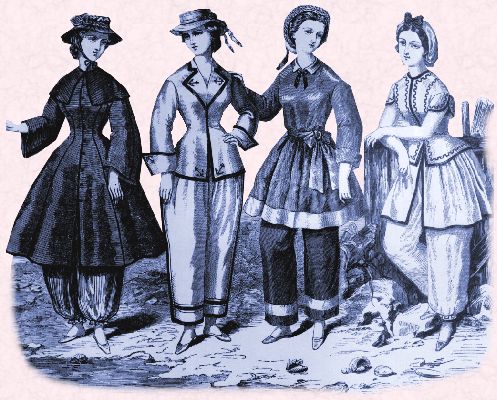
Photo: bathers in 1834. There's more on wonderful nineteenth-century bathing suits from ModCloth, Thread for Thought and Clancy's Classics.